
Case Study

Strategic Product Stratification for Portfolio Performance

Strategic Product Stratification for Portfolio Performance

Industry: Industrial Manufacturing & Distribution

Technologies: ERP, Inventory Management Systems, Procurement Data, Product Master Data, Commercial Analytics

The customer is a global industrial manufacturing and distribution organization managing a broad and complex product portfolio across multiple categories, suppliers, warehouses, and customer segments. In this environment, product availability, inventory productivity, pricing discipline, and portfolio profitability directly influence commercial performance and customer service levels.

Objective​

As the business scaled, traditional product management - driven mainly by sales volume, inventory turns, and historical demand - was no longer sufficient for a portfolio where profitability, demand variability, cost-to-serve, and strategic importance all needed to be considered together. The organization needed a clearer way to see which products created value, which supported strategic growth, and which increased operational complexity without a proportional return, so that inventory, pricing, procurement, and sales decisions could align around product value.

Challenges​​

Limited Product Profitability Visibility

The organization lacked a complete view of product-level profitability once procurement, logistics, inventory, and service costs were factored in, making it difficult to separate products that contributed to performance from those consuming resources without sufficient return.

Excess Inventory and Working Capital Pressure

Products with limited profitability or strategic value continued to consume inventory investment and warehouse capacity, creating working capital pressure and crowding out stock priority for commercially important products.

Portfolio Complexity

A large product portfolio increased procurement complexity, warehouse handling, returns management, forecasting difficulty, and service cost - with no clear way to separate products supporting strategic growth from those adding avoidable operational burden.

Pricing and Decision-Making Inconsistency

Many product decisions still relied on generic mark-up models, historical practice, or operational intuition, without a consistent stratification model linking pricing, stocking, and procurement decisions to profitability and strategic relevance.

Solutions

Product Portfolio Stratification

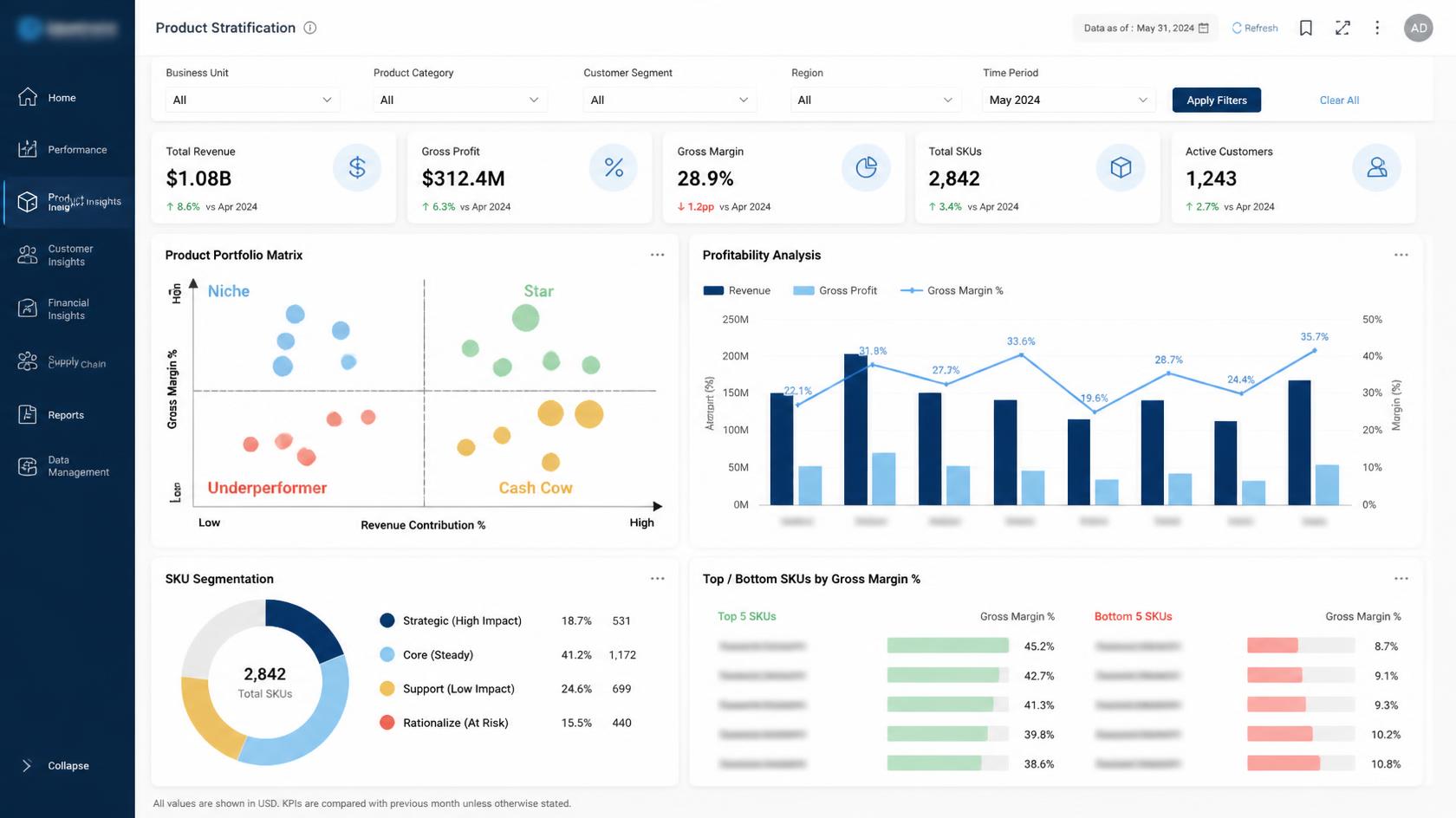
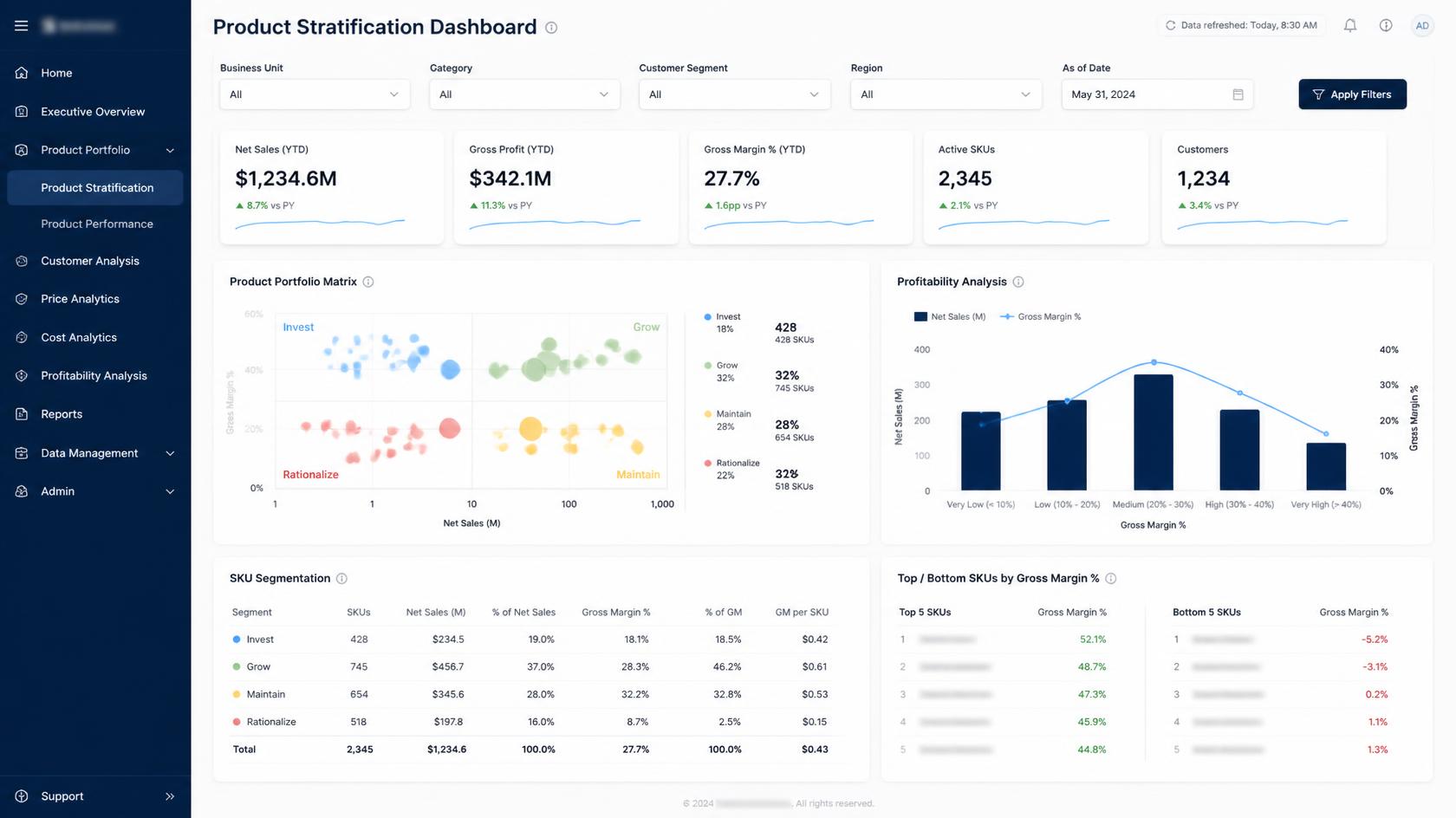
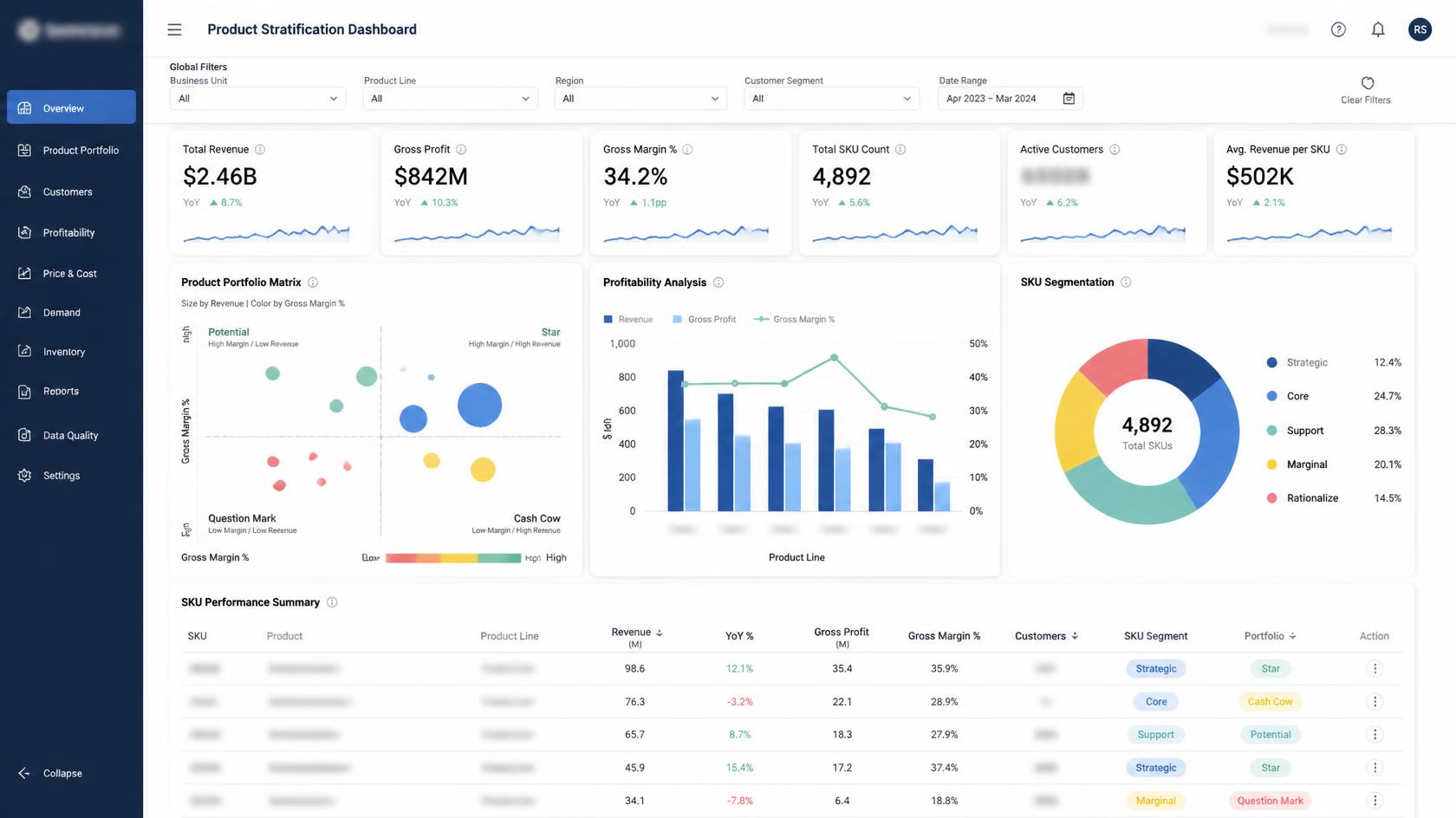
Soprex classified the product portfolio into four strategic groups: Strategic Products, Growth Products, Operational Products, and Service-Drain Products. Each group called for a different business response - from priority inventory allocation and long-term investment to rationalization, pricing adjustment, or inventory reduction.

Product Profitability Analysis

The framework evaluated products across profitability, customer importance, demand behavior, operational cost, and strategic value - giving leadership a view of total business contribution rather than revenue or volume alone. Several products previously treated as core inventory were reclassified once operational cost and service demand were factored in, revealing a pattern that had not been visible under a revenue-only view.

Inventory and Working Capital Optimization

Distinguishing value-creating products from those tying up capital with limited return gave the organization a stronger basis for stocking decisions, reducing the risk of excess or obsolete inventory.

Data-Driven Decision Making

Product ranking models, demand pattern analysis, cost-to-serve calculations, and what-if scenarios replaced historically driven decisions, improving alignment between product strategy, pricing, procurement, and supply chain planning.

Scalable Portfolio Governance

The framework was built as a repeatable model, usable across business units and product categories in future portfolio reviews rather than as a one-time analysis.

Results

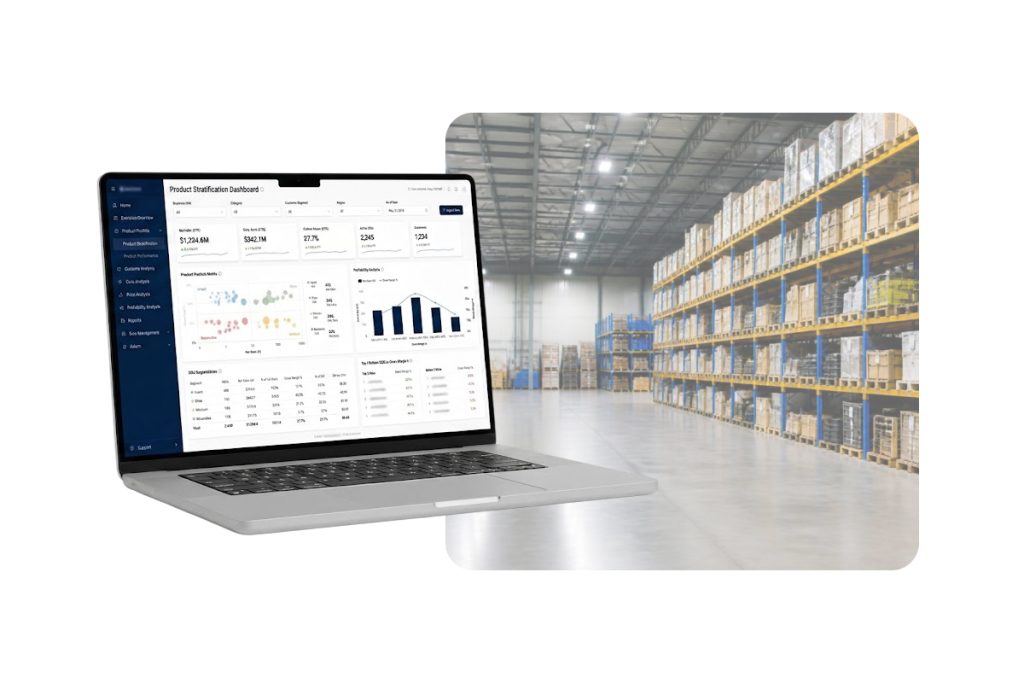
Visual representation of  use case

Sharper Operational Focus

Teams could direct procurement, inventory, and warehouse resources toward products with stronger business value, while identifying products that required optimization or rationalization - replacing a one-size-fits-all approach with strategy differentiated by profitability, demand stability, and operational impact.

Stronger Service Levels Where It Mattered

Better product prioritization helped protect availability for the most strategically important products and customer relationships, rather than spreading inventory attention evenly across the full portfolio.

A Shared Basis for Cross-Functional Decisions

Product management, supply chain, finance, procurement, and commercial teams gained a common view of product value, replacing disconnected, function-specific indicators.

Foundation for Margin and Working Capital Improvement

By separating current profitability, future growth potential, and margin-diluting complexity, the organization built a stronger basis for investment decisions, working capital reduction, and pricing discipline going forward.

4

Strategic product groups established

1

Data-driven decision framework

9

Key business outcomes supported

100%

Portfolio transparency

"Soprex helped us move from product complexity to product clarity. We now have a more structured way to understand which products create value, which products support growth, and where we need to reduce operational burden."

Client quote anonymized for confidentiality.

Ready to engineer
what's next?

Whether you're modernising a legacy estate, scaling a platform hitting its limits, integrating ERP and CRM into something that finally works, or building production-grade AI into business workflows — Soprex delivers it properly.